

Emirates Group wins UAE’s highest sustainability honour again after major green drive
Fuel savings, clean energy and recycling projects strengthen environmental performance
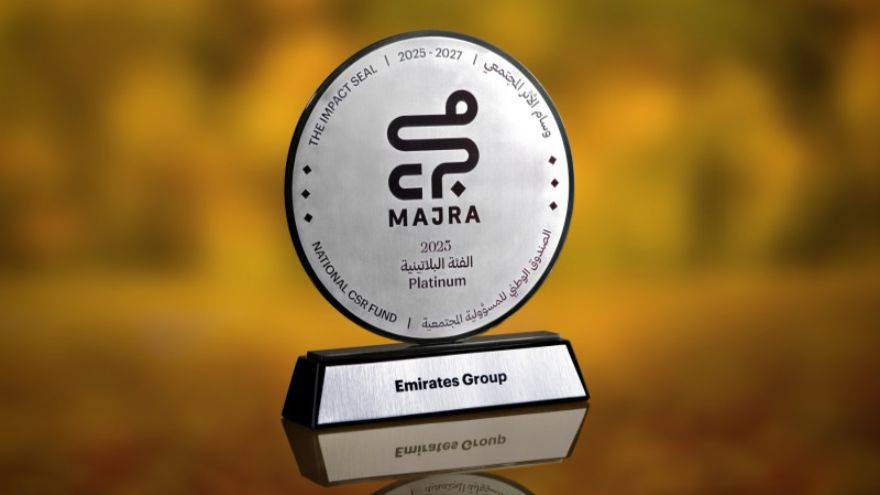
DUBAI – Emirates Group has received the UAE's highest federal recognition for sustainable business impact for the second consecutive cycle after accelerating a wide range of environmental initiatives across its aviation and services businesses.
The group was awarded the Platinum Impact Seal for 2025-2027 by the UAE National CSR Fund, Majra, recognising measurable achievements in environmental, social and governance (ESG) performance. The latest recognition comes after a year marked by significant fuel savings, increased use of sustainable aviation fuel, renewable energy investments and expanded recycling programmes across Emirates and dnata.
The Platinum Impact Seal was presented by His Excellency Abdullah bin Touq Al Marri, Minister of Economy and Tourism and Chairman of the Board of Trustees of Majra, to Adel Al Redha, Emirates' Deputy President and Chief Operations Officer. The award was presented under the patronage of His Highness Sheikh Mansour bin Zayed Al Nahyan, Vice President, Deputy Prime Minister and Chairman of the Presidential Court.
Top recognition
The Platinum Impact Seal represents the UAE's highest federal recognition for organisations demonstrating measurable and sustained performance across ESG practices. Majra evaluates organisations through a comprehensive assessment covering corporate social responsibility initiatives, sustainability performance, governance standards, overall business impact and alignment with both the United Nations Sustainable Development Goals and the UAE's national priorities.
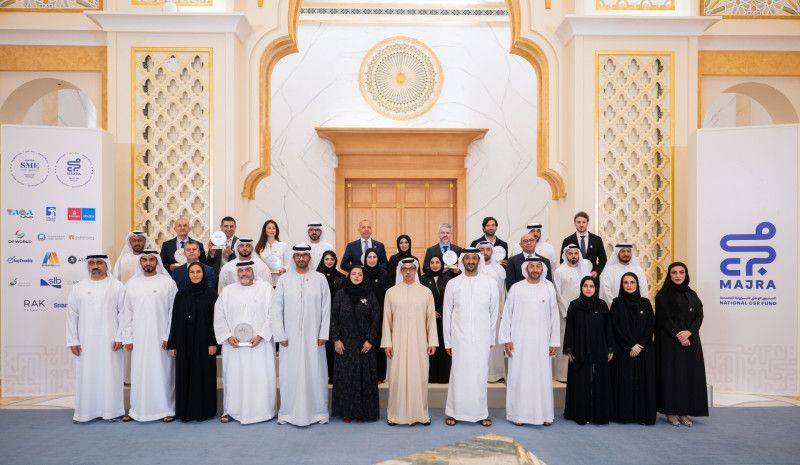
Adel Al Redha said the award reflects Emirates Group's continued commitment to advancing sustainability through practical environmental projects, responsible governance and partnerships that support long-term solutions for aviation's environmental challenges.
The group's environmental sustainability framework is built around three strategic pillars: reducing emissions, consuming resources responsibly, and preserving wildlife and natural habitats. These principles continue to shape projects across Emirates, dnata and other businesses within the group.
Fuel efficiency
Among the biggest contributors to the group's environmental progress is Emirates' Green Ops programme, first introduced in 2016 to improve operational fuel efficiency. The initiative combines pilot training, advanced data analytics, optimised flight routings and reduced engine taxiing to minimise fuel consumption without compromising operational safety.
During the 2024-25 financial year, these measures helped save more than 98,000 tonnes of fuel while cutting carbon emissions by over 312,000 tonnes.
The airline also stepped up its use of Sustainable Aviation Fuel (SAF). During 2025-26, Emirates procured more than 28,000 tonnes of SAF, contributing to a reduction of more than 93,000 tonnes in emissions.
The airline has also signed a memorandum of understanding with ENOC Group to explore joint initiatives for expanding the supply of Sustainable Aviation Fuel at Emirates' Dubai hub, supporting broader industry efforts to lower aviation emissions.
Circular projects
Emirates has continued to expand circular economy initiatives by finding new uses for materials recovered during the airline's extensive aircraft retrofit programme. Fabrics and aircraft components salvaged during cabin upgrades have been transformed into limited-edition luggage collections, with proceeds supporting the Emirates Airline Foundation.
The airline also introduced the Aircrafted KIDS programme in 2025, through which around 4,000 upcycled school bags have already been donated to children's organisations across Africa, Asia and the Middle East.
Meanwhile, Emirates' closed-loop recycling programme for inflight meal service equipment has repurposed more than 88,000 kilograms of damaged or unserviceable plastic items into new onboard products, reducing waste while extending the life of valuable materials.
Clean energy investments have also gathered pace. In October 2024, Emirates partnered with Etihad Clean Energy Development to install nearly 40,000 solar panels at the Emirates Engineering Centre. The installation now supplies 37 percent of the facility's energy requirements while reducing annual CO₂e emissions by more than 13,000 tonnes.
Emirates Flight Catering, the world's largest flight catering facility, has also commissioned a custom-built biodigester capable of processing organic waste onsite. Once operating at full capacity, the system is expected to avoid more than 2,000 tonnes of carbon emissions each year.
dnata progress
Sustainability initiatives have also expanded across dnata's global operations. The aviation services provider continues replacing diesel-powered ground support equipment with hybrid, electric and future hydrogen-powered alternatives. As a result of ongoing investments, more than 17 percent of dnata's global fleet has now been electrified.
The company has also accelerated the use of lower-carbon fuels. During the 2025-26 financial year, dnata increased its global consumption of alternative fuels by 89 percent compared with the previous year, including biodiesel, hydrotreated vegetable oil (HVO) and other emerging fuel alternatives.
This follows a landmark milestone achieved in Dubai during 2024, when all non-electric airside vehicles were transitioned to biodiesel, reducing CO₂-equivalent emissions by more than 3,500 tonnes annually.
Renewable energy has become an increasingly important part of dnata's operations. During 2025-26, onsite solar systems generated 5,126 MWh of electricity, while another 24,564 MWh was sourced through renewable electricity tariffs across its global network. Together, renewable sources accounted for 15 percent of the company's total energy consumption.
National strategy
Waste reduction remains another major focus across dnata's global business. During the 2025-26 financial year, 47 percent of waste generated across its worldwide operations was diverted from disposal through increased recycling, reuse and circular resource management programmes.
This year's Majra ceremony also marked the launch of the UAE Companies for Good 2031 Strategy, a national framework designed to strengthen private sector contributions to the country's Impact Economy while further developing the UAE's CSR, ESG and sustainability ecosystem. The initiative aims to encourage businesses across the country to expand measurable environmental and social impact in line with national development priorities.